Learning math concepts is not always easy for children and teenagers. Some students may find concepts such as numbers, patterns, sequences, coordinates, and calculations difficult or boring when they are taught only through traditional exercises. One engaging way to create a connection between math and activities that children enjoy is through coding.
Coding allows children to experience mathematical concepts in a practical way through games, animations, and interactive projects. For example, a child can use code to control the movement of a game character, calculate a game score, create geometric patterns, or design a simple math game. Through this process, math becomes more than a theoretical subject; it becomes a tool for creating and solving problems.
In this article, we explore fun ways to learn math concepts through coding and explain how programming projects can help strengthen children’s and teenagers’ mathematical skills.
What Is the Connection Between Math and Coding?
At first glance, math and programming may seem like two different subjects. However, they are actually closely connected. Programming is based on logic, sequences, patterns, variables, and problem-solving. Many of these concepts are directly related to mathematical skills.
For example, when a child increases a score in a program, they are using numerical operations. When they determine how far a game character should move, they are working with concepts related to measurement and position. Similarly, when they create a repeating pattern, they are using mathematical logic and patterns.
Therefore, coding can create an environment where children learn mathematical concepts not only by solving exercises but also by creating, testing, and experimenting.
Why Can Learning Math Through Coding Be Fun?
One of the main advantages of coding is that the result of a child’s instructions can usually be seen very quickly. Students can run a command and immediately see a character move, a shape appear on the screen, or a score change.
This immediate feedback helps children better understand the connection between the instruction they write and the result they see.
In addition, programming projects allow children to use math to create something they are interested in. As a result, learning can move beyond memorizing formulas and become a creative experience.
1. Creating Math Games
One of the most enjoyable ways to learn math concepts through coding is by designing games.
A child can create a game in which the player has to answer math questions. For example:
- Solving addition and subtraction problems to earn points
- Identifying a larger or smaller number
- Finding the correct number to complete a pattern
- Calculating the player’s score
- Using a counter to track the number of attempts
- Setting a time limit for answering questions
In such a project, the child learns programming while also working with numerical and mathematical concepts.
For example, if a player receives 10 points for every correct answer, the program needs to add the new points to the previous score. This simple operation can provide an opportunity to practice mathematical concepts.
2. Learning Patterns Through Loops
Patterns are an important mathematical concept, and they are also widely used in programming.
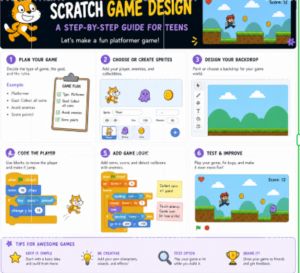
Children can use loops to create different types of patterns. For example, in environments such as Scratch, students can create a program in which a character or shape moves repeatedly to create a specific pattern.
Suppose a character needs to perform the following movement:
10 steps → turn → 10 steps → turn → repeat
Instead of writing the same commands repeatedly, the student can use the concept of repetition. Through this activity, children learn about loops while also practicing repetition and patterns.
These types of projects can help children better understand sequences, repetition, and numerical relationships.
3. Exploring Geometry by Designing Shapes
Geometry is one area of mathematics that has a strong connection with programming.
Children can use coding to create different geometric shapes such as:
- Squares
- Triangles
- Rectangles
- Polygons
- Geometric patterns
For example, when designing a square, a child needs to think about the length of its sides and the angles of rotation. If the program includes four equal movements and four turns, the student can observe the relationship between the programming instructions and the properties of a square.
This activity can make geometry a more visual and hands-on experience for children.
4. Learning Coordinates Through Character Movement
The concept of coordinates may initially seem abstract to some children. However, coding can turn this concept into an observable and interactive activity.
In environments such as Scratch, characters are positioned on the screen using specific coordinates. Children can change coordinate values to move a character right, left, up, or down.
For example, a student can design a project in which a character must travel from a starting point to a specific destination.
Through this project, children can gain practical experience with concepts such as:
- Position
- Horizontal axis
- Vertical axis
- Direction of movement
- Distance
This approach can make the basic concept of coordinates much easier to understand.
5. Using Counting in Coding Projects
Counting is one of the simplest mathematical concepts, but it has many applications in programming.
For example, a child can create a game in which the player has to collect several objects. The program can count the number of objects collected and display the result on the screen.
Through this project, children can learn about counters and see how the value of a variable changes each time an activity is completed.
These activities can also be suitable for younger children because counting can be combined with a simple game.
6. Teaching Addition and Subtraction Through Scoring
Scoring systems in games provide a good opportunity to practice basic mathematical operations.
For example, suppose a game gives the player 5 points for every correct answer. The student can design the program so that 5 points are added to the score after each correct answer.
If the player answers three questions correctly, the program needs to calculate the total score.
This simple concept can gradually be developed into more advanced projects involving different mathematical operations.
7. Using Time and Countdown Timers
The concept of time can also be practiced through coding projects.
For example, a student can design a game in which the player has only 30 seconds to answer several questions.
In this project, children can work with concepts such as:
- Countdown
- Number sequences
- Time intervals
- Time management
For older students, the project can be made more complex and used to explore time calculations and create additional challenges.
8. Learning Fractions Through Visual Projects
Fractions are among the concepts that can be difficult for some students to understand. One way to make this concept easier is through visual representation.
For example, a child can create a circle or rectangle divided into several sections and select a portion of it.
Through this activity, students can visually observe what one-half, one-quarter, or three-quarters of a shape means.
Combining images, interaction, and coding can help children better understand the relationship between numbers and quantities.
9. Creating Color and Number Patterns
Children often enjoy creating colorful and visual patterns. This interest can become an opportunity to learn mathematics.
For example, a student can create a pattern such as:
Red → Blue → Red → Blue → …
Then, the same concept can be combined with numbers:
2 → 4 → 6 → 8 → …
In the next step, the child can be asked to change the pattern or predict the next number.
These activities can strengthen pattern recognition while also encouraging logical thinking.
10. Using Variables to Better Understand Numbers
Variables are an important concept in programming and can also be used in a simple way to teach numerical concepts.
For example, a variable can store the player’s score. A child can change the value of the variable and observe the result.
As the student progresses, several variables can be used. For example:
- Player’s score
- Number of attempts
- Number of coins
- Remaining time
Through these projects, children learn that numbers can be stored, changed, and used within a program.
11. Solving Math Problems Through Coding
Coding is not only about performing calculations. One of its most important applications is problem-solving.
Instead of simply giving a child the answer to a problem, we can ask them to design a way to solve it.
For example:
If a player has 3 coins and receives 2 additional coins at each stage, how many coins will the player have after 4 stages?
Instead of solving the problem manually, the child can design an algorithm that changes the number of coins at each stage.
Through this approach, students need to break the problem into smaller steps and write an appropriate instruction for each step.
This process is an important part of computational thinking.
12. Combining Math and Storytelling
Another engaging way to teach mathematical concepts is to combine them with storytelling.
For example, a child can create a story about a character who must pass through several stages. At each stage, the character must solve a math problem before continuing the journey.
In this way, math becomes part of the story and game, and the student needs to use mathematical concepts to move the project forward.
This approach can be especially engaging for children who enjoy creativity, storytelling, and game design.
13. Using Scratch to Teach Math Concepts
Scratch is one of the suitable environments for introducing children to programming. Its visual interface allows students to implement their ideas without having to deal with the complexity of text-based programming at the beginning.
Children can create Scratch projects that use:
- Numbers
- Variables
- Counters
- Coordinates
- Angles
- Patterns
- Calculations
- Conditions and loops
The important point is that the goal is not simply to turn a math lesson into code. The goal is to create a project in which children naturally use mathematical concepts while building something.
14. Math Projects for Different Age Groups
The type of project should be selected according to the student’s age and skill level.
Younger Children
For younger children, activities involving counting, recognizing numbers, simple patterns, and moving characters can be used.
Elementary School Children
At this stage, projects can focus on addition and subtraction, multiplication, division, coordinates, patterns, and geometry.
Teenagers
For teenagers, more advanced projects can be introduced involving variables, formulas, calculations, coordinates, and mathematical algorithms.
In this way, coding can grow alongside the student’s skills, while the complexity of the projects increases over time.
Benefits of Learning Math Concepts Through Coding
Using coding to learn mathematics is not limited to teaching calculations. This approach can strengthen several important skills.
Strengthening Logical Thinking
Students learn to analyze problems step by step and create an appropriate sequence of instructions to reach a result.
Developing Problem-Solving Skills
During programming projects, children repeatedly encounter errors and challenges and need to find appropriate solutions.
Encouraging Creativity
Students can present a mathematical concept through a game, story, animation, or interactive project.
Increasing Engagement in Learning
When children can see the results of their work on the screen, they feel that they are actively involved in creating the project, making learning more engaging.
Connecting Theoretical Concepts to Real Applications
Coding shows children that numbers, patterns, coordinates, and calculations are not only topics in a textbook. They can also be used to create real projects.
The Role of Parents in Learning Math Through Coding
Parents can play an important role in creating a positive learning experience.
Instead of asking children only to find the correct answer, it can be more helpful to ask them about their thinking process.
For example:
- Why did you choose this number?
- What happens if you change the value?
- Is there another way to solve this problem?
- How can you improve this part of the game?
These types of questions encourage children to think about the problem-solving process.
It is also important to consider mistakes in coding as a natural part of the learning process. Finding and fixing an error can be just as educational as reaching the final answer.
Does Coding Replace Math Education?
No. Coding is not intended to replace the teaching of mathematical principles and concepts.
The main goal is to provide a complementary environment where students can practice and apply what they have learned. Direct math instruction remains important, but coding can help students apply their knowledge in a practical environment.
Simply put, math teaches children how to calculate and reason, while coding allows them to apply that thinking in a project.
How Can You Choose an Appropriate Math Project for a Child?
When choosing a project, it is helpful to consider several points:
- The project should match the student’s age and skill level.
- The topic should ideally be interesting to the child.
- The project should not be unnecessarily complicated.
- It should include one or more specific mathematical concepts.
- The child should have opportunities to experiment and improve the project.
- The result should be visible and interactive.
For example, instead of asking a child to simply solve several addition problems, we can ask them to design a game in which the player earns points by correctly answering addition questions.
In this way, a simple math exercise becomes a creative programming project.
Conclusion
Learning math concepts through coding can be an engaging, practical, and creative experience for children and teenagers. Designing games, creating patterns, building geometric shapes, working with coordinates, using variables, and creating scoring systems are just a few examples of ways to combine mathematics with programming.
The most important point is that coding should not be viewed simply as a tool for performing calculations. Programming can create an environment for logical thinking, problem-solving, experimentation, creativity, and the practical application of mathematics.
When children need to use numbers and patterns to build a game or project, mathematical concepts can become more meaningful and easier to understand. For this reason, combining math education with coding can be a valuable approach to creating a more active and engaging learning experience.
At CodeTurtleLab, programming education for children and teenagers focuses on creative and hands-on projects. Students can experience programming and computational thinking in a practical way by creating games, animations, and interactive projects.
You may also find the following articles useful: